Tuesday, January 30, 2007

What is Fashion?

For centuries individuals or societies have used clothes and other body adornment as a form of nonverbal communication to indicate occupation, rank, gender, sexual availability, locality, class, wealth and group affiliation. Fashion is a form of free speech. It not only embraces clothing, but also accessories, jewelry, hairstyles, beauty and body art. What we wear and how and when we wear it, provides others with shorthand to subtly read the surface of a social situation.

Fashion is also a language of signs, symbols and iconography that non-verbally communicate meanings about individuals and groups. Fashion in all its forms from tattoos and body piercing, to the newest hairstyle, is the best form of iconography we have to express individual identity. It enables us to make ourselves understood with rapid comprehension by the onlooker. How we perceive the beauty or ugliness of our bodies is dependent on cultural attitudes to physiognomy. The accepted beautiful female form that Rubens painted is subliminally undesirable nowadays, if we are to be thought beautiful in a way that the majority accepts in the 21st century. We now look to fashion magazines, fashion designers, fashion models, celebrities and even clothing shop windows to give us an idea of what the fashion trend is and how we should look.

Today an inability to refashion and reshape our bodies constantly monitoring the cultural ideal leaves us failing the fashion test. Those that pass the fashion test invariably spend their lives absorbed in a circle of diet, exercise, cosmetic surgery and other regimes. This includes always shopping in search of the ultimate garb.

Our reluctance to give ourselves a regular makeover through diet, exercise, and consistently conscious use of specific dress styles infers that we have the personality flaws of a weak willed human. We become in the eyes of fashion aficionados somewhat inadequate and imperfect in the fashion stakes. Thus we strive to keep a culturally satisfying appearance so that we feel better, whereas in fact we are striving to stay in the group, whatever type of group that may be.

Group affiliation is our prime concern with regard to fashion. As long as some group similarity is identified within the group, our personal fashion whether current or dated can belong. It is the sense of belonging marked by how we fashion ourselves that gives us that group connection.

The 3 rules of fashion;
First - a fashion is approved by others.
Then - it is copied because of competition.
Finally - it is replaced as it becomes commonplace and has ceased to fulfill its function of being distinctive.

Fashion Fact Currently in the United States fashion is a huge industry with well over 970,000 employees and with an annual turnover of 36 billion.

Monday, January 29, 2007

UNENDING LOVE

by: Rabindranath Tagore

I seem to have loved you in numberless forms, numberless times...
In life after life, in age after age, forever.
My spellbound heart has made and remade the necklace of songs,
That you take as a gift, wear round your neck in your many forms,
In life after life, in age after age, forever.

Whenever I hear old chronicles of love, it's age old pain,
It's ancient tale of being apart or together.
As I stare on and on into the past, in the end you emerge,
Clad in the light of a pole-star, piercing the darkness of time.
You become an image of what is remembered forever.

You and I have floated here on the stream that brings from the fount.
At the heart of time, love of one for another.
We have played along side millions of lovers,
Shared in the same shy sweetness of meeting,
the distressful tears of farewell,
Old love but in shapes that renew and renew forever.


www.theholidayspot.com
www.hallmark.com

Is love supposed to be a mere romantic feeling & fantasy? Does love cause delay in our achievement & ambition? Or it could be interpreted in different way??

Is it really love?
or is it just a passing feeling
am I not convinced?
a bit uncertain of the feeling

Is it the way you make me feel?
so warm with joy and laughter
or could it be the happiness
from moments spent together

The lasting bliss, the kiss I miss,
The sweetest thoughts without a touch
The heart that hurts and bears a scar
thinking how far away you are

You're on my mind most of the day
And at night I go to bed and pray
An angel soft and gentle as you
Would make my sweetest dreams come true

Thinking about you alone or in class
Writing your name on my bathroom window glass
Wishing you were here
To love hold and care
Wishing I had you with me
To cherish and to stare

Into your soft and beautiful eyes
As we both travel to the skies
And mingle with the stars above
But is it really love?


www.theholidays.com

Sunday, January 21, 2007

Does the Distance keep the Hearts fonder??

"To My Dear and Loving Husband"
Anne Bradstreet (1678)

If ever two were one, then surely we.
If ever man loved by wife, then thee;
If ever wife was happy in a man,
Compare with me, ye women, if you can.
I prize thy love more than whole mines of gold
Or all the riches that the East doth hold.
My love is such that rivers cannot quench,
Nor ought but love from thee, give recompense.
Thy love is such I can no way repay,
The heavens reward thee manifold, i pray.
Then while we live, in love let's so persevere
That when we live no more, we may live ever...

Sunday, December 24, 2006

Present Taj Mahal in the page of History;
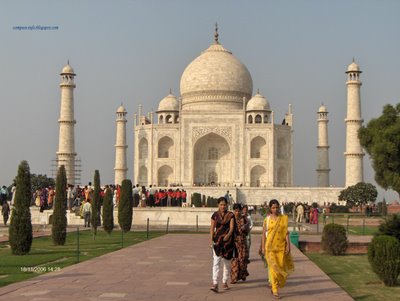
An immense mausoleum of white marble, built in Agra between 1631 and 1648 by order of the Mughal emperor Shah Jahan in memory of his favourite wife, the Taj Mahal is the jewel of Muslim art in India and one of the universally admired masterpieces of the world's heritage.

Dictionary: Mo·gul (mō'gəl, mō-gŭl') n. also Mo·ghul (mʊ-gŭl', mō-) or Mu·ghal (mū-gŭl')
- A member of the force that under Baber conquered India in 1526.
- A member of the Muslim dynasty founded by Baber that ruled India til 1857.
- A Mongol or Mongolian.
mogul A very rich or powerful person; a magnate.[Persian and Arabic muġul, from Mongolian Mo[ndot]gul.]

The Mughal Empire, (Persian: Gurkānī, which was also the self-designation of the Timurids in Central Asia and Khorasan) was an empire that at its greatest territorial extent ruled most of the Indian subcontinent, then known as Hindustan, and parts of what is now Afghanistan and the Balochistan
region.

In the early 16th century, Muslim armies consisting of Mongol, Turkic, Persian, and Afghan warriors invaded India under the leadership of the Timurid prince Zahir-ud-Din-Muhammad Babur. Babur was
the great-grandson of Central Asian conqueror Timur-e Lang (Timur the Lame, from which the Western name Tamerlane is derived), who had invaded India in 1398 before retiring to Samarkand who himself claimed descent from the Mongol ruler, Genghis Khan(Chinggis Khaan). Babur was driven
from Samarkand by the Uzbeks and initially established his rule in Kabul in 1504. It was established in 1526, enjoyed expansion and consolidation until about 1707 and survived, even if in drastically
attenuated form, until 1857. The empire was founded by the Timurid leader Babur in 1526, when he defeated Ibrahim Lodi, the last of the Delhi Sultans at the First Battle of Panipat.


Mughal is the Persian word for Mongol, and was generally used to refer to Central Asian nomads who
claimed descent from the Mongol warriors of Genghis Khan.
The Mughal rulers were adherents of Islam.


The territory was largely conquered by the Pashtun Sher Shah Suri during the time of Humayun, the second Mughal ruler, but under Akbar the Great it grew considerably, and continued to grow until the
end of Aurangzeb's rule. Jahangir, the son of Mughal Emperor Akbar and Rajput princess Mariam-uz-Zamani, ruled the empire from 1605–1627. In October 1627, Shah Jahan, the son of Mughal Emperor Jahangir and Rajput princess Manmati, succeeded to the throne, where he inherited a vast
and rich empire in India; and at mid-century this was perhaps the greatest empire in the world.

Shah Jahan commissioned the famous Taj Mahal (between 1630–1653), in Agra as a tomb for his wife Mumtaz Mahal, who died giving birth to their 14th child.


By 1710, the empire had reached its zenith with a territory spanning over 750 million acres.

Babur, a seasoned military commander, entered India in 1526 with his well-trained veteran army of 12,000 to meet the sultan's huge but unwieldy and disunited force of more than 100,000 men. Babur defeated the Lodhi sultan decisively at the first Battle of Panipat. Employing gun carts, moveable
artillery, superior cavalry tactics, and the highly regarded Mughal composite bow, a weapon even more powerful than the English longbow of the same period. Babur achieved a resounding victory and the Sultan was killed. A year later (1527) he decisively defeated, at the Battle of Khanwa, a Rajput
confederacy led by Rana Pratap Singh of Chittor. A third major battle was fought in 1529 when, at the battle of Gogra, Babur routed the joint forces of Afghans and the sultan of Bengal. Babur died in 1530
at Agra before he could consolidate his military gains. During his short five-year reign, Babur took considerable interest in erecting buildings, though few have survived. He left behind as his chief legacy a set of descendants who would fulfill his dream of establishing an empire in the Indian
subcontinent.

According to the document available in the State Library of Bhopal, Babur left the following will to Humayun:
"My son take note of the following: Do not harbour religious prejudice in your heart. You should
dispense justice while taking note of the people's religious sensitivities, and rites. Avoid slaughtering
cows in order that you could gain a place in the heart of natives. This will take you nearer to the
people.
Do not demolish or damage places of worship of any faith and dispense full justice to all to ensure
peace in the country. Islam can better be preached by the sword of love and affection, rather than the
sword of tyranny and persecution. Avoid the differences between the shias and sunnis. Look at the
various characteristics of your people just as characteristics of various seasons."

Trip to TAJ MAHAL

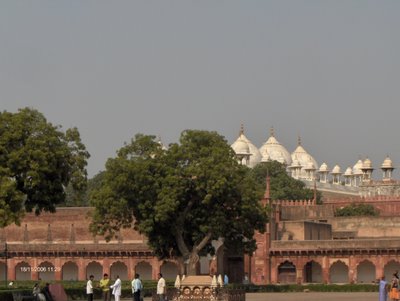
My mama has always reminded me over the phone to visit & see those wonderful sightseeing places in India during my vacation. And it was my dreams to visit one of the Seven Wonders in the World of the time, namely, Taj Mahal. Last periods while being in India, i couldn't get a perfect chance to make my dream come true. Actualy it was one of my scheduled work on my mind for which the exact time wasn't surely pointed out.

One day, i mentioned about it one of my caring best friends- Deeki, she directly accepted it & promised me that would work out. Even she already had been there, she didn't hesitate about my wish. How sweet friends are surrounding me...^^

Then last month, she, her friend & me joined a tour group- our classmate, Justin's friends- to Taj Mahal, Agra. With mercy by Heaven, everything was going smoothly, there was any holdback. I'd like to note here that the group friends was great all together and it made our trip more excellent. Trip was well-organized with friendly-warm atmosphere. They were a whole rich family everyone was there ready to help each other anytime. How admirable !! ^^
Here i get impression that if we are about to do something, then we must have done it in well-organized shape & our aim must be united, whether it would be successful or not. Plus, to respect each other is the very basis for acheiving our united goal.

Well, now I've attached some better photos here during my trip, and next time I will enclose some information on related subject here. Thank you for being with me. ^^

Sunday, October 01, 2006

Art Gallery: Mona Lisa del Gioconda

The portrait full of mystery and secrets is painted on a 77x53 cm large poplar-wood. It is the most famous work of Leonardo da Vinci.
Originally the painting was larger than today, because two columns, one on the left the other one on the right side of Mona Lisa, have been cut. That is the reason why it is not easy to recognize that Mona Lisa is sitting on a terrace.
It is also mentionable that many details are not visible today, because they are partially damaged and some parts of Mona Lisa are painted over.
However the characteristic of the famous painting is still existing. The characteristic consists in the detailed background which disappears in the misty atmosphere (this is called "sfumato" technique), the perfect portrayed Mona Lisa and of course her hypnotically smile.


It is supposed, that Francesco di Bartolommeo di Zanobi del Giocondo, one of the noblest citizen of Florence, ordered from Leonardo a portrait of his third wife Lisa di Antonio Maria di Noldo Gherardini.
Leonardo started to work at this painting in 1503. At this time Mona Lisa was twenty-four year old.
He worked at the portrait for the next four years. When Leonardo left Florence in 1507 he did not sell the painting to the orderer but he kept it for himself. Several believe, that Leonardo did not hand over the painting, because he did not finish the work, other believe that Leonardo loved the painting to much.
Leonardo da Vinci arrived with the painting in his baggage in France in the year 1516. Leonardo sold the painting in France to King Francis I., who bought it for the castle in Amboise. In the following time Mona Lisa came to Fontainbleau, Paris, Versailles and then to the collection of Ludwig XIV. After the revolution in France the painting got a new home in the Louvre. Napoleon took it away from there and hung it up in his bedroom. When Napoleon was banished Mona Lisa returned into the great Louvre in Paris.
On 21 August 1911 Mona Lisa was stolen from an italian thief, who brought the painting to Italy, where it emerged two years later in Florence. After some exhibitions Mona Lisa returned again to Paris.
An acid attempt damaged the lower half of the painting in 1956. The restoration took several years.
In the 60´s and 70´s Mona Lisa was exposed in New York, Tokyo and Moscow. Today the painting is behind bullet-proof glass in Paris in the Louvre and international terms are prohibiting any journey.


http://www.kausal.com/leonardo/monalisa.html

Friday, September 29, 2006

History: Brief History of Mongolia

Mongolia's history spans 500,000 years. From nomads herding the Central Asian steppe to the formation of the powerful Mongol empire and the gradual emergence of the Mongolian Republic, its history is steeped in conflict.

Ancient Mongolian States

The first Mongolian state was established in 209 BC by Huns or Hunnu people. The name Hunnu comes from two ancient Mongolian words. Hun means man and Nu translates as sun. The Hun's first king was Modun Shan Yui, whose father Tumen was chieftain of the Hun's most influential tribe.
The Huns territory stretched from Korea in Far East to Tian Shan Mountain in northern China and from the southern section of the Great wall to Lake Baikal in southern Siberia. From 200 B.C until its collapse in 98 AD, the Hun state was the most powerful nomadic nation residing in the sprawling Central Asian steppe and mountain. But, after three hundred years of domination the Hun state imploded, ruined by internal conflicts between powerful chieftains.


After the Huns state collapsed several other ambitious clans established their own states and dominated Mongolian territory up until 1200 AD. The first dominant state after the Hun's collapse was the Sumbe State, which lasted until the 3rd century BC. The Toba finally took over the Sumbe state in 250 AD and established its own state with a number of tribal allies. In turn the Tobas were defeated by the Nirun, who were forced to hand the state over to Turkic tribes who established the Tureg Kingdom in Mongolia 552 AD. Thousands of Turkic people had arrived from the far west via the Altai mountains during the 4th century AD. They extended the ancient feudal system, but were also defeated by their own internal conflicts 745 AD.

The Uigur tribe then became the most powerful in Central Asia, were unable to dominate the whole of Mongolia. It was the Kidans, who had peacefully coexisted with several previous ruling tribes, who took over Mongolia in 907. Their dominance lasted until the 12th century when a number of central Asian tribes invaded at the same time. There was now no ruler in Mongolia and this vast territory was divided and subdivided into tribal areas.

The Mongol Empire

Temujin, best known as Chinggis Khan was born into the Yesukhei in 1162. His father, Yesukhei, a chieftain of one of the numerous tribes was killed by the Tartars when he was at his 9 years old.
With the support of his father's fellows, Temujin established the Great Mongol State in 1189. By 1206 he united 81 different Mongolian tribes and established the Great Mongolian Empire in 1206, when he was crowned as Chingis Khan. Chingis Khan died in 1227. Subsequent Mongolian Khans were chosen from following generations of Chingis Khan's offsprings.


During the 13-14th centuries, Mongolia developed in terms of its economy, culture, military strength and politics. It was a huge, sprawling empire which encompassed many separate Asian and European nations. Still known as the golden era of Mongolian history, during this time the Mongol Empire was the most powerful nation on earth. Chingis Khan was a great military general, statesman and Mongolian national hero.


The Mongol Empire began to fall apart in 1368. This was bound up with the collapse of the Mongolian Yuan dynasty, which had been established in China after Kublai Khan named Beijing as the new Capital of the Mongol Empire.
The Manchurians conquered Mongolia in 1691 and the Manchurian colonisation lasted for 220. By the beginning of the 20th century Mongolians were embroiled in struggle for national liberation, which finally bore fruit in December 1911, when the Manchurians withdrew and Mongolia's independence was proclaimed in Urguu (as Ulaanbaatar was previously known). Mongolia's theocratic ruler Bogd Khan was awarded power across the entire country.

Socialist and Democratic Mongolia

On 11 July 1921, the socialist revolution, known as People's Revolution took place. In 1924, The Mongolian People's Party proclaimed Mongolia a People's Republic. The congress endorsed the Republic's first constitution. As Mongolia maintained strong links with the former Soviet Union, the socialist era continued until 1990, when democratic changes first started in Mongolia. In 1990 the Mongolia former communist Politburo's resigned and a multi-parliamentary system was installed. The country's first multi party election was held in June 1990. The new parliament adopted Mongolia's first democratic construction in January 1992. This constitution defined Mongolia as a democratic parliamentary republic operating with a President. Both parliament and president have to be directly elected by the general public. Throughout these political changes, Mongolia has slowly been paving its way towards a free market economy and away from the old centrally planned economy.

Religion

Traditionally, Mongols practiced Shamanism, worshipping the Blue Sky. However, Tibetan Buddhism (also called Vajrayana Buddhism) gained more popularity after it was introduced in 16th century. Tibetan Buddhism shared the common Buddhist goals of individual release from suffering and reincarnation. Tibet's Dalai Lama, who lives in India, is the religion's spiritual leader, and is highly respected in Mongolia.
As part of their shamanistic heritage, the people practice ritualistic magic, nature worship, exorcism, meditation, and natural healing.
At the beginning of the 20th century, Mongolia had hundreds of Buddhist monasteries and about 30 percent of all men were monks. Communists led an anti-religious campaign in the 1930s, which nearly destroyed the extensive system of monasteries. Under Communist rule, atheism was promoted and monasteries were closed, although shamanistic practices survived. From 1945 to 1990, only one monastery (Gandan in Ulaanbaatar) was allowed to operate. Democratic reform that started in 1990 allowed freedom of religion; well over 100 monasteries have reopened, and Qazaq Muslims are allowed to practice Islam. Many young people are receiving an education through these traditional centers of learning, and the people are once again able to practice cherished traditions.

www.juulchin.com

www.gandan.mn

Geography: MONGOLIA


A tremendous destination to experience the outdoors & a unique history dating back to the Mongolian Empire of Chinggis Khaan (Genghis Khan) .

Simply put: a land of wildlife- adventure, the horse king country, nomadic lifestyle, great open rural area of blue sky, all keeping pace with the high speed of urban flourishment…


Population: 2.8 million

Area: 1,566,000 sq km (610,740 sq ml)

Average Altitude: 1,580 m above the sea level

Land boundaries: 8,158 km. (with Russia 3,485 km & with China 4,673 km)

Terrain: Vast semi desert, & desert plains, mountains in west & south west, Gobi Desert in South east

People: Khalkh Mongols (86%), Kazakhs (6%), about a dozen other Mongolian minor ethnic groups

Language: Mongolian, Russian, Chinese, English is widely spoken in the capital city Ulaanbaatar (Ulan-Bator)

Religion: Tibetan Buddhism, Muslim, Christian, & Shamanism

Literacy rate: 82.9% (higher in the world)

Climate: Average summer temperature +20°C, Average winter temperature -26°C, Average rainfall 200-220
Winter lasts December-February, Spring season for March-May, Summer lasts June-August, Autumn season for September through November.


Political system: By 1990s it transformed peacefully from 7 decades of Socialism into Democracy. Parliamentary republic. The President & members of State Great Khural (Parliament ) are elected for 4 years by the national election. The Prime Minister is elected by the Government for 4 years as well.


Legislature: Mongolian judicial system consists of Constitutional Court, Supreme Court, Aimag (province) & capital city into districts: districts into khoroos.